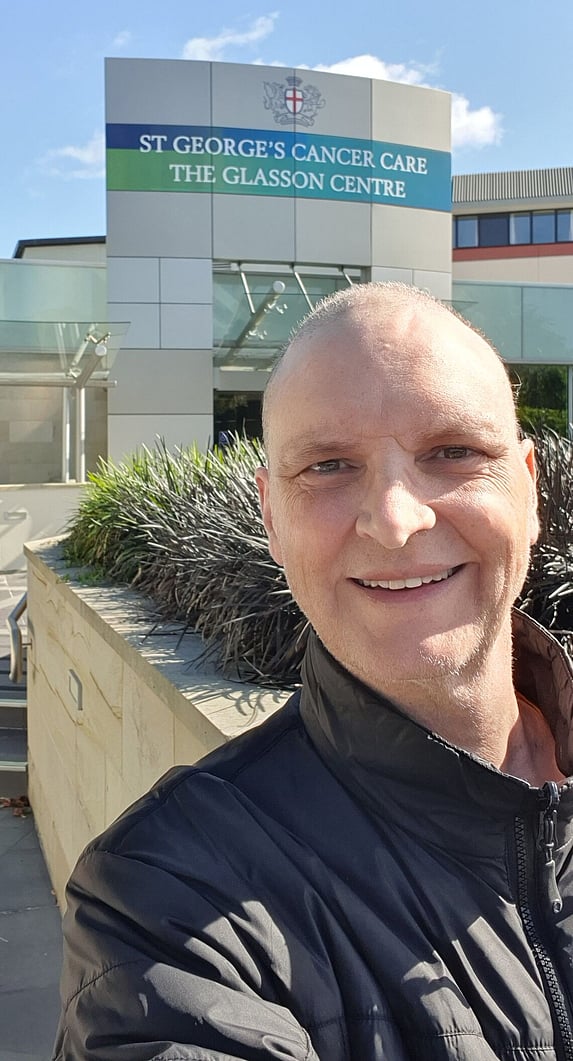
Andrew's Story
When Andrew Edgar was diagnosed with stage 2 oesophageal cancer in August 2024, he was 51 years old. Life was already busy, with a move between cities and changes in work, and cancer was the last thing he expected. Looking back now, Andrew can see there had been warning signs earlier that year, but at the time they did not seem serious enough to point clearly to cancer.
In January 2024, he began having acid reflux in his throat and waking in the night feeling as though his breathing was obstructed. He sought medical advice, but the symptoms were put down to reflux and he was told he likely needed more omeprazole. In hindsight, Andrew feels this may have been a missed opportunity to investigate further.
A few months later, things changed. Around May, swallowing became more difficult. At first it was certain foods, like carrot, then bread. By July, the problem had become impossible to ignore. He could barely swallow at all because his oesophagus had become blocked.
From there, things moved quickly. Andrew was fortunate to have private health insurance, which meant he was able to get an endoscopy without delay. The scope confirmed cancer, and he was referred straight to an oncologist. Even in those early days, he made a choice about how he wanted to face what was ahead.
“From day one I was always determined to be on the right side of the 50% survival rate,” he says. “So far I am still on the right side.”
Treatment was intensive. Andrew underwent chemotherapy, then major keyhole surgery in which half his stomach and part of his oesophagus were removed, followed by more chemotherapy. His final round of treatment ended in March 2025.
He describes parts of his care as very good, especially at the point of diagnosis and during the chemotherapy sessions themselves. On chemo days, there were two nurses overseeing treatment across the week and he generally felt well looked after in the chair. But what stands out just as strongly are the gaps: the times between appointments, the questions that went unanswered, and the sense that some parts of his recovery were left to him to figure out on his own.
Andrew experienced peripheral neuropathy, likely linked to a combination of chemotherapy and heart medication, but says there was little conversation about how his cardiac and cancer treatments might interact. He also felt that some of the side effects he experienced were treated too generically.
“My nurses seemed to be treating me generically for chemo-related reactions,” he says. “But I suspect my cancer meant I had different digestive reactions which they just didn’t understand. Of course we all have different reactions to chemo, and I think that wasn’t always taken into account.”
For Andrew, digestive issues became one of the biggest challenges, especially after surgery. He did receive some dietitian input during chemotherapy, but he describes it as general rather than tailored to his situation. After surgery, when his body had changed dramatically and eating had become a completely different experience, there was no ongoing dietitian support. Instead, he had to work out for himself what he could eat, how much, and what his new normal looked like.
“Changed diet as a result of surgery, all self-discovery,” he says.
That self-reliance extended into other parts of treatment too. After his last round of chemotherapy, he says there was little follow-up, despite the side effects he was still dealing with. He recalls practical problems that felt surprisingly hard to solve, including issues around dressings and the removal and disposal of his chemo pump. Because the pump needed to be taken out by an oncology nurse, he was lucky there was one available at Hanmer surgery. But even then, the used equipment could not be disposed of there, so with PPE provided, it ended up sitting in his garage for two weeks.
These may sound like small details, but for someone in treatment, they add up. They can leave a person feeling as though they are carrying not only the weight of cancer, but also the burden of navigating a system that does not always join the dots.
Emotionally, Andrew also felt alone in ways he had not expected. At one point he shared a chemotherapy ward with a woman who had stomach cancer and had undergone total stomach removal. He remembers thinking how positive she was, and even feeling lucky by comparison. But despite being surrounded by cancer care, he never felt there was anyone specifically there for people with oesophageal or other upper gastrointestinal cancers.
“At no time during my diagnosis and treatment was I ever told there was a group who specifically supported those with oesophageal or gut cancers,” he says. “I actually felt quite alone from that perspective.”
While he did receive some support from the Cancer Society, he was unable to talk to anyone who understood his specific cancer, and practical support felt patchy. He remembers hearing about a clinic in Hanmer only at short notice, sometimes with just an hour’s warning before it was due to start.
Now, one year on from finishing treatment, Andrew is living with the long tail of cancer: the physical changes, the side effects that linger, and the knowledge that recovery is not simply about reaching the end of chemo or surgery. It is about rebuilding life afterwards.
And yet, through all of this, what comes through is his determination, honesty, and a deep desire to make things better for others.
Andrew wants other people with oesophageal cancer to know that they are not weak if they find it hard. The treatment is tough. The surgery is life-changing. Recovery is not straightforward. But he also wants people to know that it is possible to keep going, to adapt, and to find your feet again, even when so much has changed.
He is also keen to use his experience to help others feel less alone than he did. He wants to listen to people going through treatment now, share what he has learned, and offer the kind of cancer-specific understanding he struggled to find himself. He would also like to speak with nurses and doctors, particularly about the importance of more individualised support for digestive symptoms, side effects, and life after surgery.
For Andrew, telling his story is about opening the door for others in the same boat. To anyone newly diagnosed, or supporting someone with oesophageal cancer, his message is clear: this journey can be frightening and isolating, but you do not have to lose hope. Ask questions. Trust what your body is telling you. Keep advocating for yourself when something does not feel right. And remember that survival statistics are not destiny.
Andrew knows that because he has lived it.
“I was determined to be on the right side of the 50% survival rate,” he says. “So far I am still on the right side.”
We thank Andrew for bravely sharing his journey as part of Oesophageal Cancer Awareness Month to increase awareness and help others feel less alone.