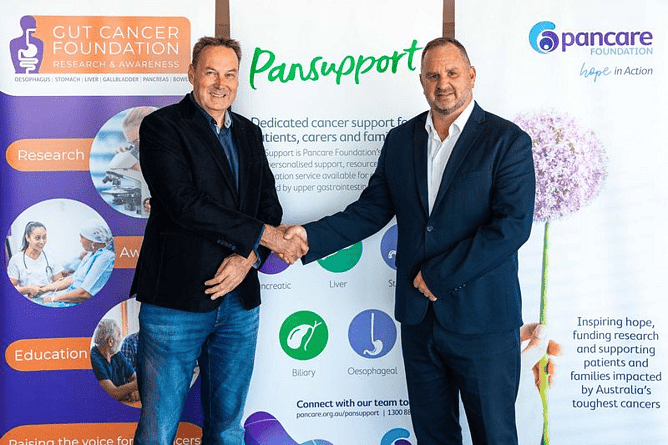
Gut Cancer Foundation and Pancare Foundation join forces to develop a new support service for people affected by upper gastrointestinal cancers in Aotearoa New Zealand
Gut Cancer Foundation (GCF) has announced a new partnership with Australian charity Pancare Foundation to help develop a support service for New Zealanders affected by upper gastrointestinal (GI) cancers, including cancers of the pancreas, stomach, liver, oesophagus, gallbladder and bile duct.
Late last year, GCF signalled its intention to build a dedicated supporter service for people affected by upper GI cancers. Today’s announcement explains how that service will be developed – through a structured partnership that draws on Pancare’s experience and a well-established Model of Care, adapted carefully for the New Zealand context.
Under the partnership, GCF will licence and locally adapt Pancare’s evidence-informed Model of Care and related systems. The model is designed to improve the coordination and quality of support offered alongside clinical care patients already receive. It will be implemented in stages in Aotearoa, starting with a pilot phase before any wider roll-out as a nurse-led, supportive care service.
“New Zealanders with upper GI cancers often face complex treatment pathways and very tough diagnoses,” says Liam Willis, Executive Officer of Gut Cancer Foundation. “Around 2,500 people here are told each year that they have an upper GI cancer. For many of these cancers, survival remains among the lowest of the major tumour types and the support patients and whānau need is complex, specific and needs to be tailored to their diagnosis.
Despite this, there is currently no dedicated support service in New Zealand specifically for people with upper GI cancers and their whānau. We have been clear that we want to change that, but also that we would move carefully and base any new service on evidence and experience.
Partnering with Pancare allows us to learn from years of work in Australia and then adapt that learning so it fits our health system, our communities and our obligations to patients here. This collaboration is about building something that is right for Aotearoa, to fill a gap of unmet need without starting entirely from scratch.”
Andrew Edgar was diagnosed with oesophageal cancer in August 2024. His experience highlights the gaps that currently exists and just what a difference a dedicated supportive care service could have made for him...
“I felt quite alone during my treatment, and the support I was given was very general. Digestive cancers come with their own unique challenges, so It’s awesome to hear that Gut Cancer Foundation is establishing a service to provide support specific to these cancers. This would have been invaluable during my treatment.”
The collaboration brings together Pancare’s Model of Care with GCF’s local relationships and understanding of the New Zealand health environment. The Model of Care will be adjusted for New Zealand clinical pathways and cultural context, with a GCF nurse responsible for delivery on the ground.
Doug Hawkins, CEO of Pancare Foundation, says: “We have seen in Australia how structured, evidence-informed supportive care can make a meaningful difference for people living with upper GI cancers and for those who care for them. We are pleased to be working with Gut Cancer Foundation to share what we have learned and to support the development of a service tailored to New Zealand’s needs.
This partnership is grounded in shared values – respect for patients, a focus on quality, and a belief that specialist charities can achieve more when they work together.”
A unique trans-Tasman collaboration
This is a trans-Tasman partnership between two specialist charities focused on upper GI cancers. By bringing together Australian experience and evidence with New Zealand insight and relationships, GCF and Pancare aim to increase the impact of their work across borders.
The partnership is structured so that Pancare provides the framework, tools and implementation support, while GCF leads New Zealand delivery and holds ongoing rights to use locally adapted elements of the model to deliver a high quality, scalable service.
“We see this as a genuine two-way collaboration,” says Willis. “Pancare is sharing a model they have developed over many years. In return, our work to adapt and implement it in New Zealand will contribute to a broader understanding of how best to support people with these cancers in different health systems. Ultimately, it is people affected by upper GI cancers in both countries who stand to benefit.”
Staged, careful implementation
The project is following a phased, low-risk approach:
Feasibility: testing how the model fits within the New Zealand context, including referral pathways, data and privacy requirements, and workforce needs.
Pilot: trialling the nurse-led, supportive care service with patients and whānau, and evaluating feedback and outcomes.
Business as usual: Use the learnings and evaluation from the pilot to embed the service over time as part of GCF's ongoing work.
Throughout, the partnership will prioritise patient privacy, data security, cultural safety and ethical practice. Any service will be designed to complement, not replace, clinical care and existing support services.
Building capability for the long term
In addition to sharing its Model of Care, Pancare will provide training, implementation support and ongoing guidance. This is intended to help GCF build the internal capability needed to run and refine the service over time.
“From our perspective this is not just about a framework or a piece of technology,” says Willis. “It is about equipping our team to offer consistent, high-quality support alongside the clinical care that people receive, and to keep improving that support as we learn.”
The project is currently in design, with the intention to begin piloting the nurse-led service in May 2026. Further information about the pilot, including referral pathways, will be shared closer to launch.