Every August, Gut Cancer Foundation raises awareness of stomach cancer, including its risk factors, symptoms and the urgent need for earlier detection.
Our key areas of focus for Stomach Cancer Awareness Month 2026 include:
improving understanding of stomach cancer symptoms, risk factors and the importance of early detection
highlighting the connection between Helicobacter pylori (H. pylori) infection and stomach cancer risk
increasing awareness of hereditary stomach cancer, including CDH1 gene mutations and the importance of knowing your whakapapa
sharing the experiences of patients and whānau affected by stomach cancer
connecting patients, whānau and carers with free stomach cancer support and trusted information
promoting access to our free Stomach Cancer My Care KIT
highlighting stomach research, clinical trials and studies.
More than 400 people are diagnosed with stomach cancer in Aotearoa each year, but the burden is not shared equally. Māori are three times more likely to develop the disease than New Zealand European communities, reflecting a significant health inequity.
Around 47% of stomach cancers are diagnosed in an emergency setting, often after the disease has reached a later stage. Earlier detection is therefore critical, with greater awareness of the symptoms, risk factors and importance of whānau health history to improve outcomes.
Recognising the symptoms of stomach cancer
The symptoms of stomach cancer can be subtle, vague and easily mistaken for other conditions. They can include:
extreme tiredness
a painful or burning sensation in the abdomen
heartburn or dyspepsia
black-coloured stools
unexplained weight loss
feeling full after eating only a small amount
nausea or vomiting
loss of appetite
swelling or pain in the abdomen
low iron levels or anaemia.
Experiencing one or more of these symptoms does not necessarily indicate stomach cancer. However, new, persistent or unexplained changes should be discussed with a GP, particularly when they are unusual for the individual.
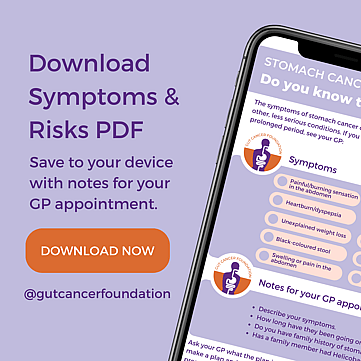
Our downloadable Stomach Cancer Risks and Symptoms Checker can help people record symptoms and prepare for a conversation with a healthcare professional.
H. pylori and stomach cancer risk
Helicobacter pylori, more commonly known as H. pylori, is a bacterium that can infect the stomach lining. Long-term infection can cause inflammation and precancerous changes and is a major cause of stomach cancer.
Māori and Pacific peoples have higher rates of H. pylori infection than New Zealand Europeans, contributing to the inequities seen in stomach cancer diagnoses and deaths in Aotearoa. Risk may also be increased when a close family member has tested positive for H. pylori.
Updated H. pylori guidelines are being developed for health professionals, providing further guidance on identifying, testing and treating people who may be at increased risk.
Health professionals: View the updated H. pylori guidelines here: https://www.nzdoctor.co.nz/article/educate/how-treat/helicobacter-pylori
Gut Cancer Foundation also welcomes recent news from the Malaghan Institute of Medical Research. The Institute has entered a global collaboration with the International Agency for Research on Cancer, the cancer research agency of the World Health Organization, to strengthen stomach cancer prevention and control through H. pylori research.
The collaboration will include work addressing antibiotic resistance, developing screen-and-treat strategies, and sharing scientific knowledge and methods internationally.
Read more here: https://www.malaghan.org.nz/research-and-expertise/clinical-trials-and-studies/stomach-cancer-prevention
Whakapapa and hereditary stomach cancer
Whakapapa can provide important information about stomach cancer risk.
Hereditary Diffuse Gastric Cancer is a rare inherited condition most commonly associated with a mutation in the CDH1 gene. A CDH1 mutation can be passed from one generation to another and increases the risk of developing diffuse-type stomach cancer.
New Zealand has a disproportionately large number of HDGC because the CDH1 gene has been found to be carried in a number of whānau Māori. Current guidance recommends that the whānau of any Māori person diagnosed with diffuse stomach cancer be encouraged to consider genetic testing, regardless of whether there are other known cases of stomach cancer in the family.
Understanding whānau health history and sharing it with a healthcare professional may help identify whether genetic counselling, testing or surveillance should be considered.
Learn more about hereditary stomach cancer and the CDH1 gene: https://www.gutcancer.org.nz/hereditary-stomach-cancer/
Sharing the realities of stomach cancer
Throughout Stomach Cancer Awareness Month, we are sharing personal journeys from patients and whānau whose experiences demonstrate why symptoms, risk factors and whakapapa must be taken seriously. Gut Cancer Foundation is deeply grateful to:
Amy* and her boys, whose journey demonstrates the importance of recognising hereditary diffuse stomach cancer within whakapapa and advocating for appropriate genetic testing
Carl, who shares how severe fatigue and anaemia led to his diagnosis, despite experiencing few obvious stomach symptoms
Jess, who has shared the story of her brother Chris, who died from a rare cancer in his stomach lining at just 37
Tara and Marty, who share their experience of a diagnosis following persistent reflux, unexplained weight loss and falling iron levels
Rachel and Mary, whose difficult journey to an H. pylori diagnosis began when Mary was only 14.
By speaking openly about their experiences, they are helping others recognise the warning signs, understand risks, advocate for further investigation and feel less alone. We are so grateful to these patients and whānau for sharing their journeys.
Read their personal journeys on our Stomach Cancer Awareness Month page.
Dedicated support for patients and whānau
Gut Cancer Foundation’s free, nurse-led telehealth support service is available for people affected by stomach and other upper GI cancers.
Our support nurse helps patients, whānau and carers understand what may happen following a diagnosis, prepare notes for their medical team, navigate the health system and manage the practical effects of cancer and its treatment.
The service is available to:
people diagnosed with upper gastrointestinal cancers, including stomach, oesophageal, pancreatic, liver and biliary cancers
whānau and family supporting people with upper GI cancers
people with related conditions or high risk factors for upper GI cancers
people concerned about upper GI cancer
Patients, whānau and carers can refer themselves for support, while healthcare professionals can refer patients or carers directly to the service.
Access our support service: https://www.gutcancer.org.nz/support-service/
Refer yourself or whānau for support: https://www.gutcancer.org.nz/refer-myself-or-whanau
Refer a patient for support: https://www.gutcancer.org.nz/health-care-professional-referral
My Care KIT for stomach cancer
The Stomach Cancer My Care KIT is now available to support patients, whānau and carers throughout the stomach cancer journey.
Created with evidence-based information from stomach cancer experts, the KIT helps people understand a diagnosis, explore treatment options and navigate the different stages of living with stomach cancer.
It is available free as either a digital download or printed KIT, with free shipping throughout Aotearoa.
Order a Stomach Cancer My Care KIT: https://www.gutcancer.org.nz/shop/#category=44594&gsc.tab=0

Supporting stomach cancer research and clinical trials
Thanks to the generosity of our donors, Gut Cancer Foundation funds research, clinical trials and studies that aim to improve understanding, treatment and outcomes for people affected by stomach cancer.
Current donor-supported projects include research exploring Māori perspectives on the use of living tissue models, as well as studies and trials relating to treatment, chemotherapy side effects and more personalised approaches to stomach cancer care.
These projects include:
Understanding Māori Perspectives: Using Living Tissue Models
Monitoring Cardiotoxicity from 5-FU Chemotherapy
THYmine2
APEC
TOPGEAR
Learn more about stomach cancer trials and studies: https://www.gutcancer.org.nz/projects-our-donors-support/#stomach
Supporting Stomach Cancer Awareness Month
Individuals, whānau, workplaces, healthcare professionals and communities can support Stomach Cancer Awareness Month by:
learning about stomach cancer, its symptoms and risk factors
downloading the Stomach Cancer Risks and Symptoms Checker
downloading and sharing awareness resources across whānau, communities, workplaces and healthcare practices
staying updated on stomach cancer research, funding, news and advocacy
donating to Gut Cancer Foundation to support stomach cancer research, awareness, advocacy and patient support.
Gut Cancer Foundation extends its sincere thanks to every patient, whānau member, healthcare professional, researcher, partner and supporter who has contributed to Stomach Cancer Awareness Month.
Support Stomach Cancer Awareness Month 2026: https://www.gutcancer.org.nz/stomach-cancer-awareness-month/